
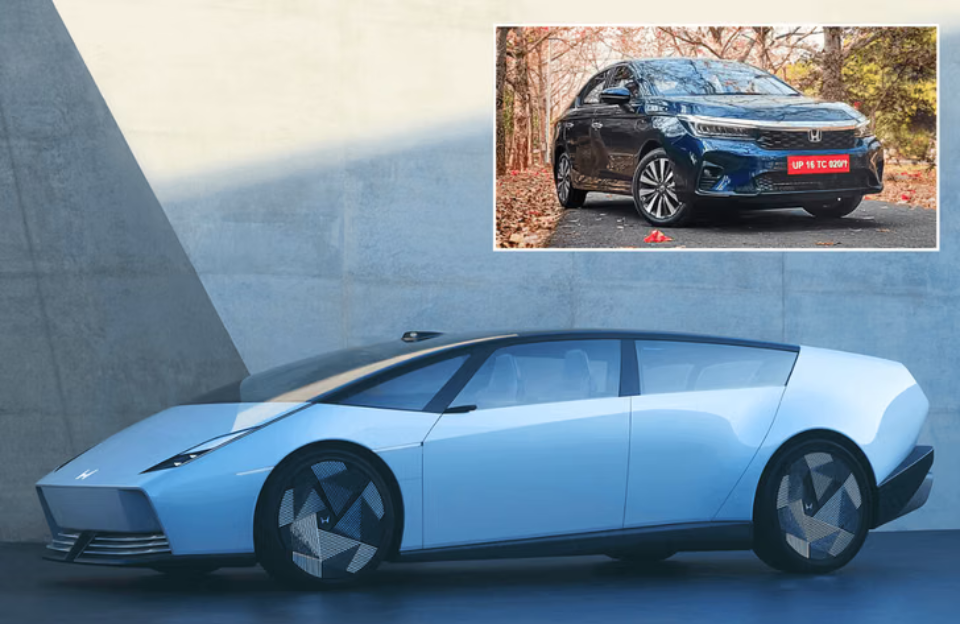
The iconic Honda City is gearing up for its most dramatic transformation yet. Scheduled for launch in 2028, the sixth-generation City will adopt a bold design direction inspired by Honda’s futuristic 0 Series sedan concept revealed at the Japan Mobility Show. While the 0 Series sedan itself is a flagship electric model, its styling philosophy will set the tone for all future Honda sedans — including the City.
This generational shift comes at a crucial time for Honda India. Once the undisputed leader of the midsize sedan segment, the City has gradually slipped behind newer, more sophisticated rivals such as the Hyundai Verna, Skoda Slavia and Volkswagen Virtus. The all-new City aims to reclaim that position with a stronger identity, innovative design, and a more advanced hybrid strategy.
Radical New Design: Sleeker, Sharper and More Athletic
According to early design mock-ups viewed by industry insiders, the 2028 Honda City carries strong visual similarities to the 0 Series sedan. Expect a far sportier and more aerodynamic profile featuring:
- A sleeker front fascia with a crisp, modern lighting signature
- A more aggressive and athletic stance
- The return of a front quarter glass, a feature reminiscent of the Lamborghini Countach
- Sharply contoured surfaces and a more sophisticated silhouette
While the 0 Series sedan showcased dramatic pop-up headlamps, these will not make it to production due to current safety regulations. But the overall styling will be a major departure from the current, conservative fifth-generation City.
Built on Honda’s New PF2 Platform
The next-gen City is expected to shift to Honda’s PF2 modular architecture, designed to support midsize sedans, compact SUVs and — importantly — hybrid powertrains. The PF2 platform brings several advantages:
- Around 90kg lighter, enhancing performance and efficiency
- Higher body rigidity, improving handling and crash safety
- Shared parts across multiple models, lowering production costs
- Optimised for hybrid systems, including improved energy regeneration and faster battery charging
This platform is central to Honda’s strategy to meet strict CAFE 3 norms that take effect from 2027.
Hybrid Powertrain to Take Centre Stage
The hybrid-powered City will finally become a mainstream offering rather than a niche, high-priced variant. Better localisation and parts sharing are expected to significantly reduce costs, allowing Honda to position the hybrid City more competitively.
Engine options are likely to follow the familiar format:
1.5L Naturally Aspirated Petrol (Updated)
- Approx. 121hp
- 6-speed manual and CVT options
Next-Gen 1.5L Atkinson-Cycle Hybrid
- Expected combined output around 126hp
- Dual electric motors
- e-CVT transmission
- Improved efficiency and battery performance
With rising fuel prices and hybrid interest increasing rapidly in India, the new City hybrid is expected to play a major role in Honda’s lineup.
A Critical Model for Honda India
The Honda City is the brand’s longest-running and most iconic nameplate in India, introduced in 1998. While the first three generations set benchmarks in performance and innovation, the last two iterations focused on safety, space and reliability. But with segment rivals now offering stronger engines, more features and advanced technology, the City needs a major reinvention.
Sales numbers reflect this urgency — City sales dropped to 578 units in October 2025, a sharp 42 percent decline year-on-year. The next-gen model aims to revive the brand’s momentum in the sedan category.
With a radical new design, a lighter and more advanced platform, and a more accessible hybrid system, the 2028 Honda City could mark the most significant shift in the model’s 25-year history.